
This article covers six genetic evaluation activities you can log in Breedr:
- PAP Score (Pulmonary Arterial Pressure)
- Residual Feed Intake (RFI)
- Muscle Ultrasound
- Docility Score
- Foot Score
- Udder Score
- Pelvic Score
How to Log a Genetic Evaluation Activity:
All six activities follow the same path. The steps below apply to every activity in this article.
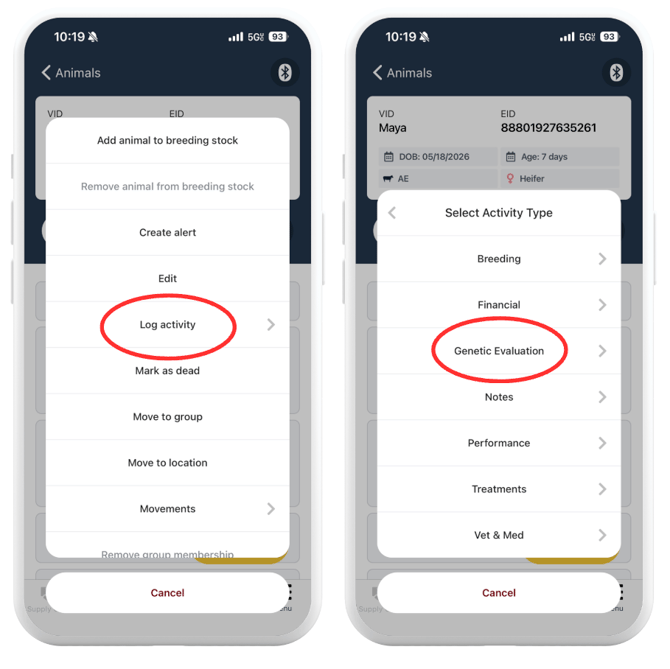
On the app:
- Find the animal in My Cattle and tap its record.
- Tap the yellow "+ Manage" button.
- Tap "Log Activity."
- Select "Genetic Evaluation" from the activity categories.
- Select the specific activity (e.g. "RFI," "Docility Score").
- Enter the measurement or score.
- Tap "Save."
During a Chute Session:
Genetic evaluation activities can also be logged during a Quick Weigh or Quick Scan session using the same "+ Manage" > "Log activity" path. On iPad in landscape, several of these activities are also available as Quick Actions. See Quick Actions in Chute Mode.
On the Web Browser:
- Log in at app.breedr.tech.
- Open the animal's record from My Cattle.
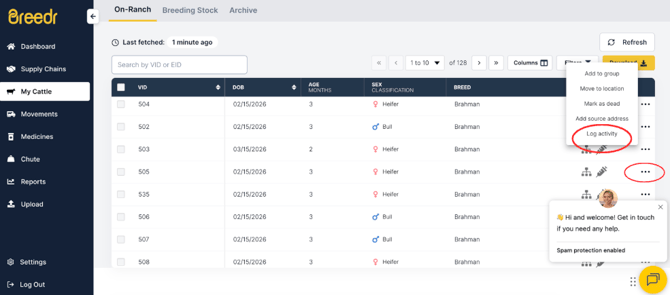
- Click the three dots (...) on the far right of the table.
- Click "Log activity" > "Genetic Evaluation" and select the specific activity.
- Press "Confirm"
- Enter the measurement or score, then click "Save."
Via File Upload:
- Log in at app.breedr.tech and go to Import Data > Custom Import > Genetic Evaluation.
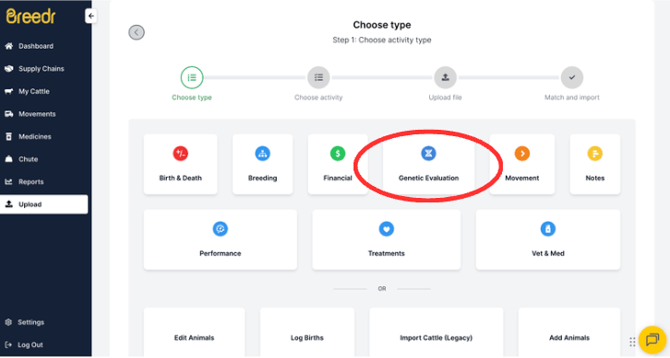
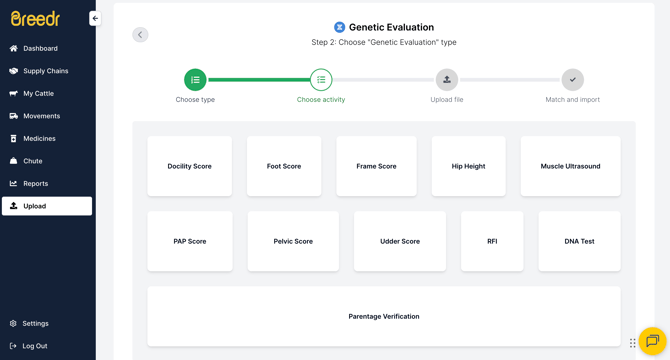
4. Upload, map your columns, and click "Finish Upload."
PAP Score (Pulmonary Arterial Pressure)
What it is: PAP testing measures the blood pressure inside an animal's pulmonary artery, the vessel carrying blood from the heart to the lungs. It is expressed in millimeters of mercury (mmHg) and is the primary tool for identifying cattle susceptible to High Altitude Disease (HAD), also known as brisket disease or high mountain disease.
Residual Feed Intake (RFI)
What it is: RFI measures feed efficiency, specifically, the difference between how much an animal actually eats and how much it was predicted to eat given its size and growth rate. A lower (more negative) RFI means the animal is more efficient: it achieves the same growth using less feed than expected. A higher (positive) RFI means the animal eats more than predicted for its performance level.
Muscle Ultrasound
What it is: Ultrasound scanning uses sound waves to measure internal carcass traits on a live animal -- primarily ribeye area (REA), backfat thickness (BF), rump fat (RF), and intramuscular fat percentage (IMF, or marbling). A trained technician or veterinarian scans the animal between the 12th and 13th rib on the left side.
Docility Score
What it is: Docility score measures an animal's temperament and response to handling. It is typically recorded during weighing or processing when the animal is in a squeeze chute. Most US breed associations use a 1 to 6 scale:
Foot Score
What it is: Foot score evaluates the conformation of an animal's feet and legs -- specifically hoof angle, heel depth, claw set, and leg structure. Recording foot scores lets you identify animals with structural problems that affect longevity and mobility, and supports selection for sound feet in future generations.
Udder Score
What it is: Udder score evaluates udder conformation and teat size in females. Most evaluations use a 1 to 9 scale where 5 is ideal. A score of 1 indicates a very pendulous or poorly attached udder with large teats; a score of 9 indicates an extremely tight, high udder with very small teats. Both extremes create calving and nursing problems.
Pelvic Score
What it is: Pelvic measurement quantifies the size of a heifer's or cow's pelvic opening, recorded as pelvic area in square centimeters (height x width). It is measured rectally using a Rice pelvimeter and is typically performed on yearling heifers 60 to 90 days before their projected calving date.
Viewing Genetic Evaluation Data:
All genetic evaluation records appear on each animal's activity history timeline. To view them:
- Open the animal's record from My Cattle.
- Scroll to the activity history section.
- Filter by "Genealogy" to see only these records.
Genetic evaluation data also appears in the relevant breed association reports and in Breedr's Sire and Dam Performance report. See Sire and Dam Performance.
Submitting Data to Your Breed Association:
Data recorded in Breedr can be exported and submitted to your breed association as part of their genetic evaluation programs. For submission requirements and formats, contact your association directly:
- American Angus Association: angus.org
- Red Angus Association of America: redangus.org
- American Simmental Association: simmental.org
- American Hereford Association: hereford.org
- American Gelbvieh Association: gelbvieh.org
Need some help?
Use the chat window in the bottom right of the screen, call our Customer Success team at (737) 412-3131, or email us at supportusa@breedr.co.